
Navigating Property Tax Appeals in Georgia and Colorado
Property tax assessments continue to rise across the U.S., driven by post-pandemic appreciation, delayed reassessment cycles, and evolving state tax policies. For property owners and advisors, understanding appeal systems is more than an administrative task—it’s a material financial strategy.
Two states that highlight both complexity and opportunity are Georgia and Colorado. While both offer structured appeal rights, their timelines, processes, and recent trends differ in ways that may significantly affect outcomes.
Georgia Property Tax Appeals: Speed, Simplicity, and Strict Deadlines
How the System Works
Georgia operates on a county-driven annual reassessment cycle, with appeals typically handled through the Board of Equalization (BOE) or alternative hearing options. The process follows a predictable sequence:
- Assessment notice issued (typically April–June)
- Appeal filed with the county
- Hearing before the BOE or the hearing officer
- Optional escalation to Superior Court
Critical Deadline: 45 Days (No Exceptions)
Georgia is known for one of the strictest appeal deadlines in the country:
- Property owners have 45 days from the assessment notice date to file an appeal
- Failing to meet the deadline results in automatic forfeiture of appeal rights
This tight window is one of the biggest drivers of missed savings opportunities.
Main Benefits
- Annual appeal opportunity (unlike some states with multi-year cycles)
- Potential value freeze for up to 3 years after a successful appeal
- Relatively accessible process for property owners
Risks & Challenges
-
- A compressed timeline requires fast data gathering
- County-level variation in procedures
- Appeals must focus strictly on value—not tax rate
Colorado Property Tax Appeals: Multi-Tiered and Deadline-Driven
How the System Works
Colorado uses a multi-step appeal system with both local and state-level options:
- Protest to County Assessor
- Appeal to the County Board of Equalization
- Further appeal to the Board of Assessment Appeals, District Court, and Arbitration
This layered structure provides flexibility—but adds complexity.
Key Deadlines to Know for Colorado Property Tax Appeals
Colorado deadlines vary slightly by county, but follow a general framework:
- May 1 – June (early June): Initial protest window
- June 1 or June 8: Common statutory protest deadlines
- July through September: BOE hearings
- 30 days after BOE decision: Deadline for further appeal
Unlike Georgia’s single hard deadline, Colorado requires tracking multiple sequential deadlines.
Main Benefits
- Multiple appeal pathways (administrative, judicial, arbitration)
- Opportunity to escalate unfavorable decisions
- Appeals can impact two-year valuation cycles, amplifying savings
Risks & Challenges
- More complex navigation between levels
- County-specific variations pertaining to deadlines and procedures
- Higher likelihood of needing professional representation
Recent Trends Driving Appeals Activity
Across both states, several macro trends are fueling increased appeal volumes:
1. Rapid Valuation Increases – Colorado has seen a 30–50% value spike in some areas, increasing the immediacy of appeal. In addition, Georgia’s fast-growing metro markets (Atlanta, etc.) continue to see reassessment pressure.
2. Greater Awareness of Appeal Rights – More property owners recognize that assessments are mass-appraisal estimates, not precise valuations.
3. Data-Driven Appeals – Successful appeals increasingly rely on comparable sales, property condition evidence, and market timing adjustments.
4. Legislative Adjustments – Colorado has recently clarified and standardized deadlines and procedures to improve consistency.
Georgia vs. Colorado: Key Differences at a Glance
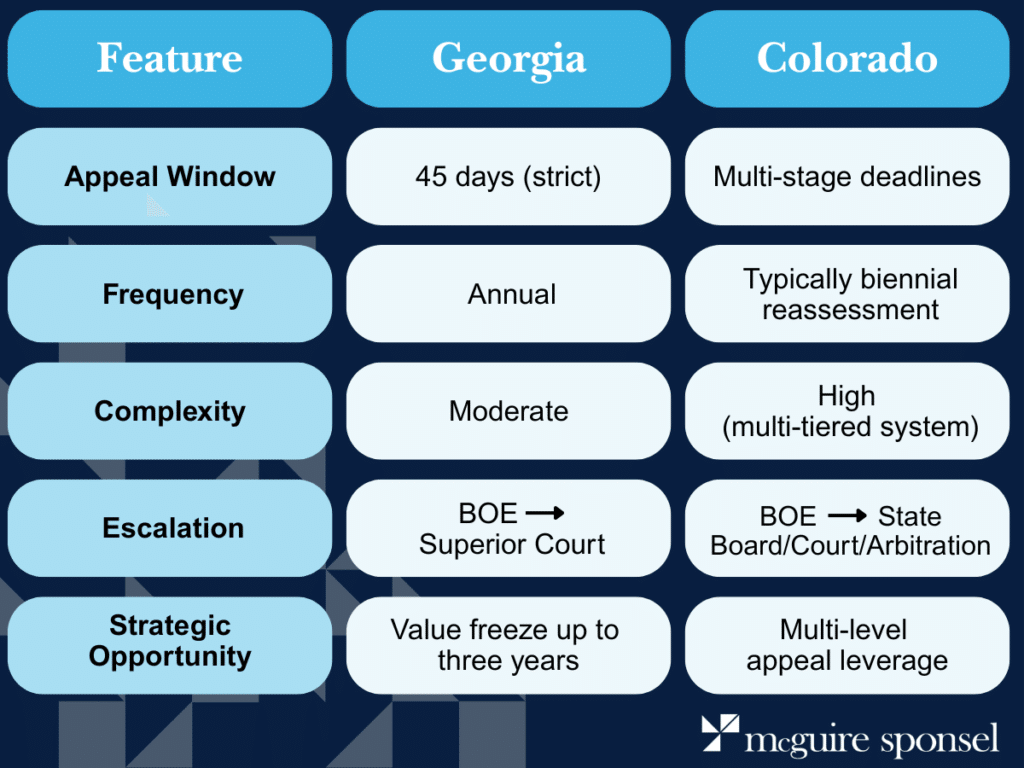
What This Means for Property Owners and Advisors
Both states offer meaningful opportunities to reduce tax liability, but only for those who act strategically and on time. In Georgia, success hinges on speed and preparation within a fixed window, while in Colorado, success depends on navigating a complex, multi-step process without missing sequential deadlines. In both cases, missed deadlines mean missed savings. For organizations managing multiple properties or simply trying to avoid leaving money on the table, the reality is clear: deadlines are tight, processes are technical, and evidence requirements are increasing.
Turn Complexity Into Cost Savings
At McGuire Sponsel, we help property owners and portfolio managers identify overassessed properties quickly, track state-specific deadlines automatically, and build data-backed appeal cases using market comps and valuation analytics. Our team is equipped to navigate multi-state appeal processes with confidence, whether you’re operating in Georgia’s fast-moving annual cycle or Colorado’s multi-tier system, turning complexity into measurable tax savings.
If you’re not appealing, you’re probably overpaying.
Let’s change that.
Contact us today for a complimentary property review. Discover if you are over-assessed and learn how we can help reduce your property tax liability.
-

Rebecca Patterson, Realtor®

Rebecca Patterson is a Tax Consultant on our Property Tax Services team.
Recent Resources
-
 in the newsFixed Asset ServicesMarch 9, 2026
Why 2026 Is Becoming A Make-Or-Break Year For Depreciation Planning
by Dave McGuireIn his latest piece in Forbes, Dave McGuire offers insight on why 2026 is shaping up to be a critical...
-
 white papersFixed Asset ServicesFebruary 27, 2026
Qualified Production Property FAQs
by Dave McGuireDownload McGuire Sponsel’s Qualified Production Property (QPP) FAQ Guide for expert insights on IRS Notice 2026-16, QPP eligibility, depreciation elections,...
-
 blogFixed Asset ServicesFebruary 13, 2026
Iowa Commercial & Industrial Property Tax Appeals: When to Challenge an Assessment
by Rebecca PattersonIowa commercial property tax appeals can present significant savings opportunities when assessments diverge from market realities. This article helps CPAs...
-
blogFixed Asset ServicesJanuary 29, 2026
Navigating the Oklahoma Property Tax Appeal Process — and How Market Conditions Impact Your Valuation
by Rebecca PattersonUnderstand Oklahoma’s property tax appeal process and how market data for office and retail properties can support valuation protests.